TechMark Arena 2026 is a transdisciplinary master thesis school where the students work on projects within the scope of DCC research. TechMark Arena 2026 focuses on the topic of Electrification of pulp and wood components.
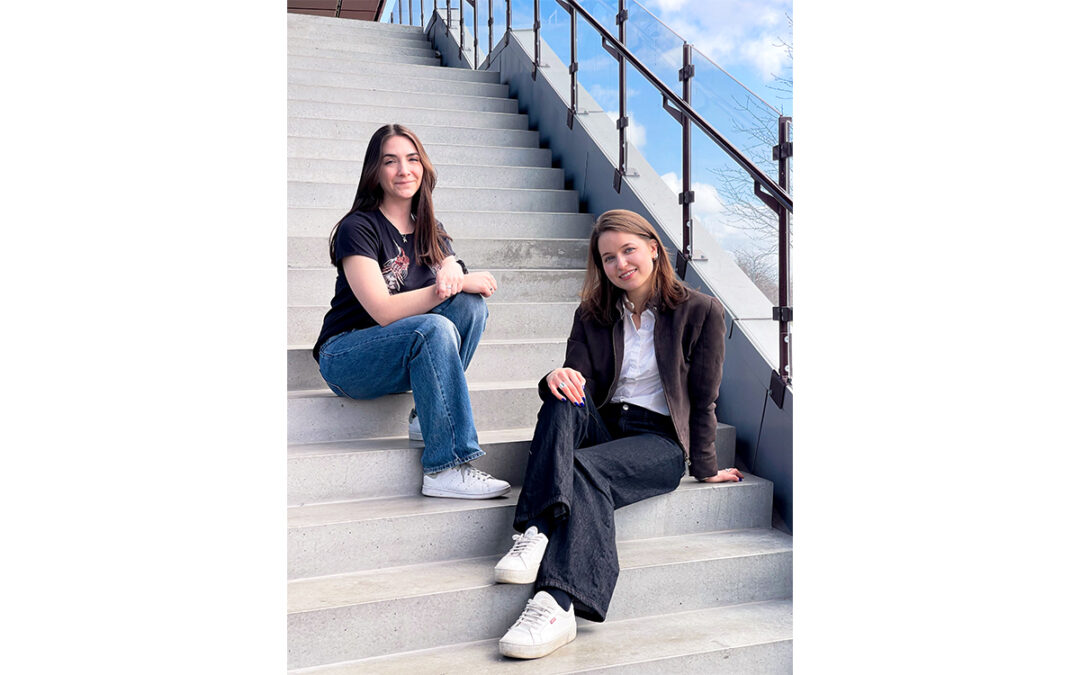
We asked our students to write about themselves and their research. Here is Mayte Uribe Vieites & Renata Autere.
Designers in research: An unexpected collaboration
At first glance, design and research might appear as two distinct worlds, but what if they are, in practice, far more closely intertwined than one might assume? Designers are not typically the first people you expect to find in a research institute, yet, this is exactly where we find ourselves. So how did we end up here?
We are two designers with different paths coming together for our Master Thesis Project. Firstly, Renata with a foundation in graphic design and communication, has a focus on concept generation and user experience. Whereas Mayte has a background in industrial design, exploring material innovation and product development. Together, we set out to bridge the gap between research and industry, where design meets a bigger context.
As MSc students in Design from Linköping’s University, we have partnered with RI.SE and the Digital Cellulose Center to pursue an exploratory design investigation of graphene paper devices. A material that at face value appears almost unimaginable, a paper-like substrate with underlying properties such as electrical and thermal conductivity. Certainly, a remarkable breakthrough that raises a fundamental question: will it be confined within high technological areas, or will it quietly integrate into our everyday life? Whatever the answer to this question might be, what if its technical capabilities are not, in fact, the primary source of its value? Driven by these inquiries, the aim of this project is to assess the relevance and industrial potential of graphene paper as a novel technological substrate. By developing a contextual framing, our work aims to create coherent value propositions for a product or range of products that utilise this material.
Central to this project, and particularly interesting to us, is the fact that with it we are able to demonstrate that design is far more than aesthetics. It is a holistic process of asking the right questions, uncovering the “why” behind things, and piecing together insights that lead to meaningful solutions. At its core, it’s about shaping purpose-driven outcomes that keep people at the center, after all they are our most valuable resource. Without the ability to ask questions, gather experiences, challenge assumptions, and learn from experts, industry representatives, users, and colleagues, our work wouldn’t be possible. People are experts in their own experiences, and without collaboration, who would we truly be designing for?
Finally, we have chosen to integrate within our project the focus of our master’s, sustainability. By constantly grounding our work in real-world contexts, we are able to critically reflect on how our projects can contribute to positive changes, not only through the environmental impact of materials and production, but also by considering how a solution might encourage climate‑positive behaviour. Often the use phase of a product carries the biggest environmental footprint, which is why we have to think beyond the design and study the product throughout its entire life cycle, in the hands of real people. Through this approach we are able to bridge technical details with industrial needs, user interactions, and environmental responsibility.
So, while design and research might appear as two distinct worlds, in practice, they are far more connected than what we might assume. We are grateful to our supervisors, Andreas Fall and Hjalmar Granberg, as well as our wonderful colleagues at RI.SE, for their support in this unexpected collaboration, and for trusting us to contribute, in our own way, to bridging the gap between research and industry.
/Mayte & Renata